
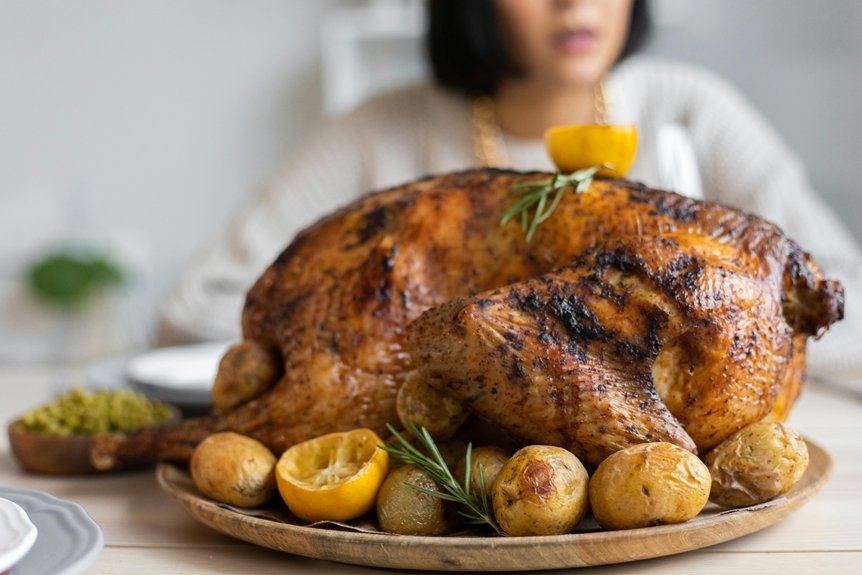
A bone-in turkey breast cooks in roughly 20 minutes per pound at 350°F—so a 5-pounder takes about 100 minutes. I’d pull it from the oven when it hits 155–160°F internally, then let it rest 10–15 minutes to reach the safe 165°F mark. The bone actually keeps moisture locked in, giving you juicier slices. Use a reliable thermometer, position your oven rack low, and tent with foil if the skin browns too fast. For timing adjustments, temperature picks, and carving tricks that’ll make your turkey shine, there’s plenty more to discover.
Why a Bone-In Breast Cooks Faster (And Stays Juicier)
Ever wonder why a bone-in turkey breast finishes cooking so much quicker than roasting a whole bird? The answer lies in size and structure. A bone-in turkey breast is simply smaller, so heat penetrates faster through the meat. Here’s the real game-changer: that bone acts like a moisture guardian. It slows water loss during oven roasting, which means you’ll get juicier slices every time.
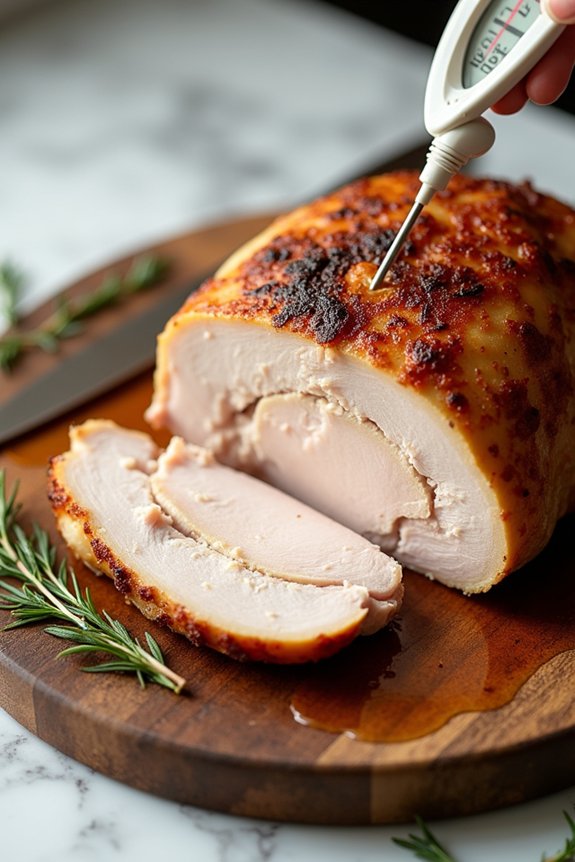
For cooking time, plan on approximately 20 minutes per pound. You’re aiming for an internal temperature of 155–160°F in the thickest part. Then comes the smart move—resting. Let it sit for a few minutes so carryover cooking raises the temperature to a safe 165°F. This combination of faster cooking and bone-preserved juiciness makes bone-in breasts genuinely hard to mess up.
350°F or 400°F: Which Temperature Should You Choose?
I’ll help you decide between these two temperatures based on what matters most to you. If you’re after a juicier, more evenly cooked breast, I’d go with 350°F, which gives you that gentle, gradual roasting over 1½ to 2½ hours, though your patience’ll be rewarded with tender meat. However, if crispy skin and a faster dinner are your priorities, 400°F gets the job done in just 36–42 minutes for a 3-pound breast, trading some moisture for that satisfying golden exterior.
Lower Temperature for Moistness
What’s the secret to turkey breast that stays juicy instead of turning into cardboard? Lower temperature roasting. I recommend setting your oven to 325–350°F for a bone-in turkey breast. Yes, it takes longer—roughly 15–20 minutes per pound—but here’s why it’s worth the wait: slower cooking reduces moisture loss significantly.
At this lower temperature, your meat retains tenderness and juiciness throughout the roasting process. I pull the breast from the oven when the internal temperature reaches 155–160°F, then let it rest for 10–15 minutes. During resting, carryover cooking brings it safely to 165°F for doneness guidance without overdrying the white meat.
You’re joining countless home cooks who’ve discovered that patience with temperature pays off deliciously.
Higher Heat Faster Cooking
If you’re short on time, higher heat’s your answer. Roasting your bone-in turkey breast at 400°F cuts cooking time dramatically. A 3–5 lb bone-in breast typically cooks in about 1 hour to 1 hour 40 minutes—no waiting around. The real bonus? You’ll get beautifully crispy skin that everyone loves.
Here’s the catch: you’ll need an internal thermometer to stay on top of things. Remove your bone-in turkey breast when it hits 155–160°F in the thickest part, then let it rest. That resting period brings the temperature up to a safe 165 degrees while keeping meat juicy. Higher heat demands attention, but the speed and results make it worth the effort.
Best Choice Comparison
So which temperature should actually guide your roasting decision—375°F or 400°F? I’ll help you choose based on your priorities and cooking style.
Here’s what matters most:
- 375°F route: Takes 1½–2½ hours for an 8–9 lb bone-in turkey breast; gentler, forgiving cooking
- 400°F route: Faster cooking with crispier skin; demands close attention to prevent overcooking
- Temperature matters most: Internal temperature of the thickest part determines doneness, not roasting time
- Target 155–160°F: Pull your turkey breast out at this point before resting
- Carryover cooking wins: During the rest period, temperature rises to 165°F naturally
I recommend 375°F if you’re newer to roasting. It’s more forgiving. Choose 400°F when you’re confident monitoring closely. Either way, trust that internal temperature reading—it’s your real guide to perfectly cooked turkey breast every time.
How to Calculate Exact Cook Time by Weight and Temperature
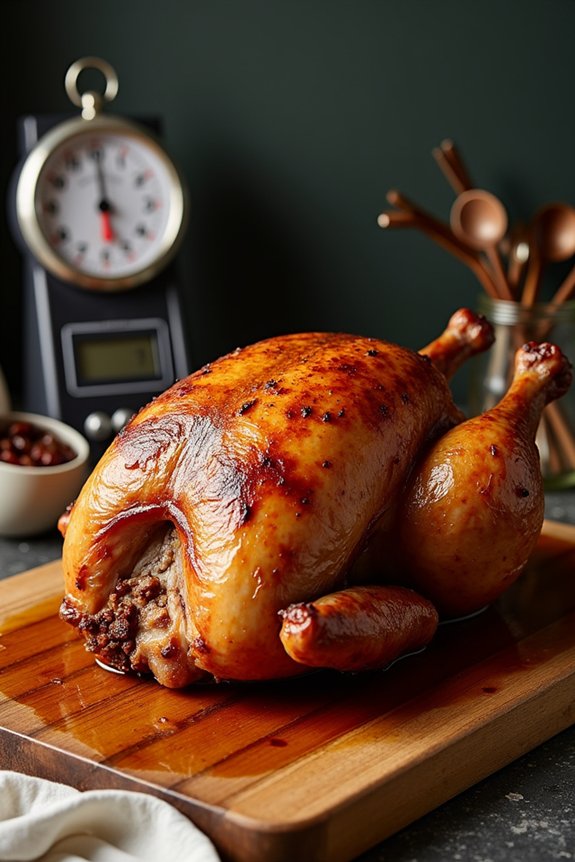
I’ll walk you through the two key steps that’ll take the guesswork out of your turkey breast cooking time. First, use the weight-based formula: multiply your breast’s weight in pounds by 20 minutes, then adjust up or down depending on thickness and your oven’s quirks—thicker breasts need a bit more time, while thin ones cook faster. Second, don’t rely on time alone; instead, use an oven-safe thermometer to verify doneness by checking that the thickest part hits 155–160°F, then let it rest for 15 minutes until it reaches a safe 165°F—this two-step temperature check is your insurance policy against either dry or undercooked poultry.
Weight-Based Cooking Formula
The simplest way to nail your turkey breast’s cooking time is using the 20-minutes-per-pound rule at 375–400°F. I’ll walk you through calculating your exact oven roasting time so you join the ranks of confident cooks.
Here’s your weight-based cooking formula:
- Multiply your breast’s weight by 20 minutes for the base cooking time
- A 5-pound bone-in turkey breast needs roughly 100 minutes (1 hour 40 minutes)
- Larger breasts scale up—an 8–9 pound breast requires 160–180 minutes
- Use a meat thermometer to verify internal temperature reaches 155–160°F at the thickest part
- Add 15 minutes rest time after removing from heat, bringing doneness guidelines to the USDA-safe 165°F
This approach removes guesswork. Your meat thermometer becomes your best friend, confirming you’ve nailed the internal temperature target every single time.
Temperature Verification Method
Why does relying solely on cooking time leave so many home cooks with undercooked or dried-out turkey breast? The answer is simple: every oven’s personality differs. That’s where your thermometer becomes your best kitchen buddy.
I recommend inserting an oven-safe thermometer into the thickest part of your bone-in breast, avoiding the bone itself. You’re aiming for an internal temperature of 155–160°F before removing it from heat. Don’t panic—this isn’t your final temperature. During the 15-minute rest period, your meat continues cooking gently, rising to a safe 165°F.
Thermometer placement matters enormously. Position it correctly, and you’ll nail doneness every single time. This method eliminates guesswork entirely. You’re no longer gambling with dinner—you’re guaranteeing perfectly juicy, safely cooked poultry. That’s confidence worth having.
Prepare Your Turkey Breast: Dry Brining and Pre-Roasting Setup
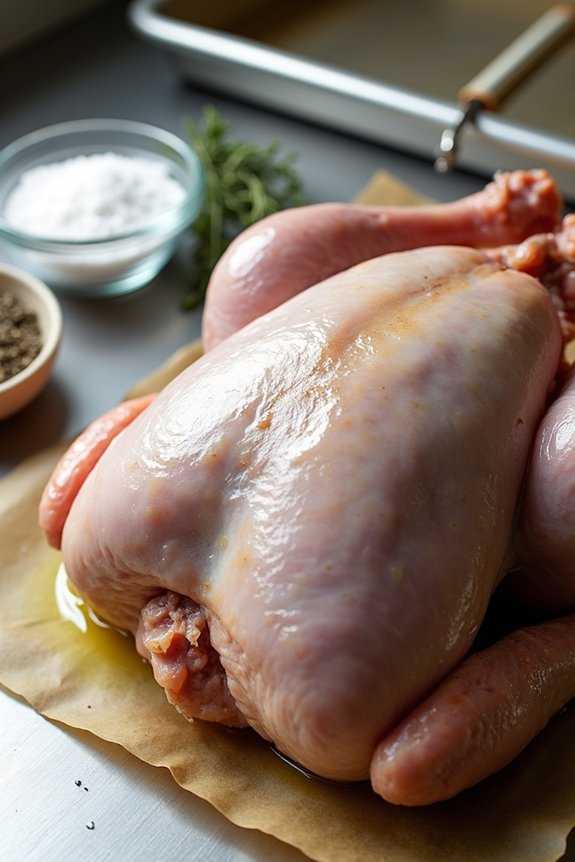
Want your turkey breast to actually taste amazing instead of just okay? I’ve got you covered with the perfect pre-roasting setup.
Start with dry brining your bone-in turkey breast by salting it generously and refrigerating uncovered for one to three days. This transforms the meat’s flavor and texture completely. Here’s what I do next:
Dry brine your bone-in turkey breast for one to three days to completely transform its flavor and texture.
- Remove the breast from the fridge 30 minutes before roasting for even cooking
- Preheat your oven to 375°F
- Set up a roasting rack in a large rimmed sheet pan for proper air circulation
- Blend melted butter with garlic, rosemary, paprika, salt, and pepper for your herb butter rub
- Pour pan broth into the bottom to maintain moisture
This pre-roasting setup guarantees juicy, flavorful results every time.
Get Your Thermometer and Oven Rack Ready
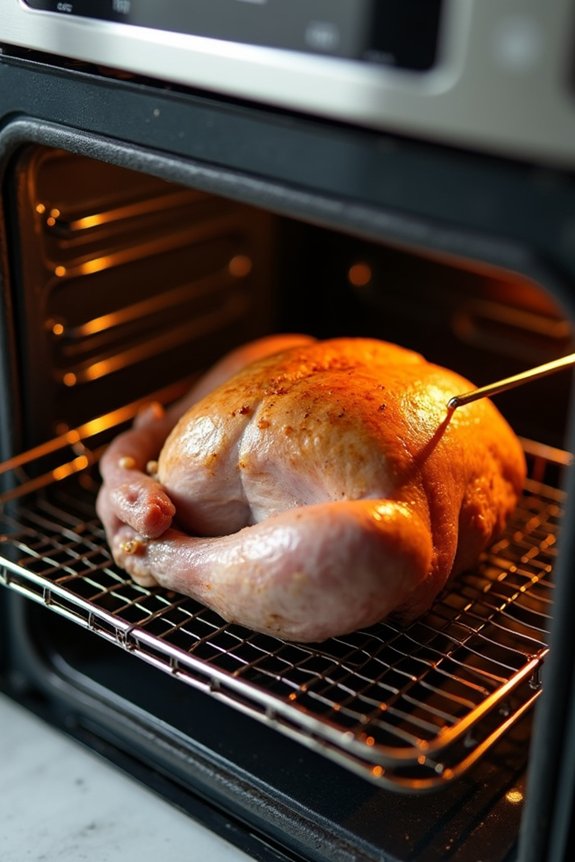
Before you get that turkey breast in the oven, I need you to gather two critical tools: an oven-safe thermometer or wireless probe (which’ll take the guesswork out of doneness) and a reliable digital meat thermometer as your backup plan. Next, adjust your oven rack to the lower third so your roasting pan sits in the sweet spot for even cooking, and remove any upper racks to let heat circulate freely around the bird—think of it as giving your turkey some breathing room. Preheat your oven to 350–375°F, and if you’re using a probe, insert it into the thickest part of the breast now so you can monitor the internal temperature without opening the oven door every five minutes.
Essential Equipment Checklist
- Meat thermometer (instant-read or wireless probe) to monitor doneness accurately
- Roasting pan with rack for optimal air circulation and crispy skin
- Paper towels to pat your bone-in turkey breast dry before seasoning
- Small bowl for mixing compound butter with garlic, thyme, rosemary, sage, salt, and pepper
- Digital thermometer to verify the thickest part reaches 155–160°F before resting to 165°F
Preheat your oven to 350–375°F and position the rack in the lower third. When you’ve got these essentials ready, you’re set for success. Trust me, this preparation step saves you headaches later and ensures perfect results every time.
Oven Preparation Steps
Now that you’ve gathered your equipment, it’s time to get your oven and thermometer ready for the main event.
First, preheat your oven to 350–375°F and position the rack in the lower third. This placement ensures even heat distribution around your bone-in turkey breast. Next, set up your roasting pan with a rack inside, then pour 1–2 cups of broth or water into the bottom. This liquid keeps everything moist during cooking—your hidden advantage for juicy results.
Insert your thermometer into the thickest part of the breast without touching bone. This tells you exactly when you’ve reached doneness. Finally, remove your turkey breast from the refrigerator about 30 minutes before roasting. Room temperature meat cooks evenly, giving you that crispy skin we’re all after.
| Step | Action | Why It Matters |
|---|---|---|
| 1 | Preheat oven | Even cooking |
| 2 | Position rack | Optimal heat |
| 3 | Add liquid | Moisture retention |
| 4 | Insert thermometer | Accurate doneness |
| 5 | Bring to room temperature | Crispy, golden skin |
Monitor for Doneness Starting at 65 Minutes
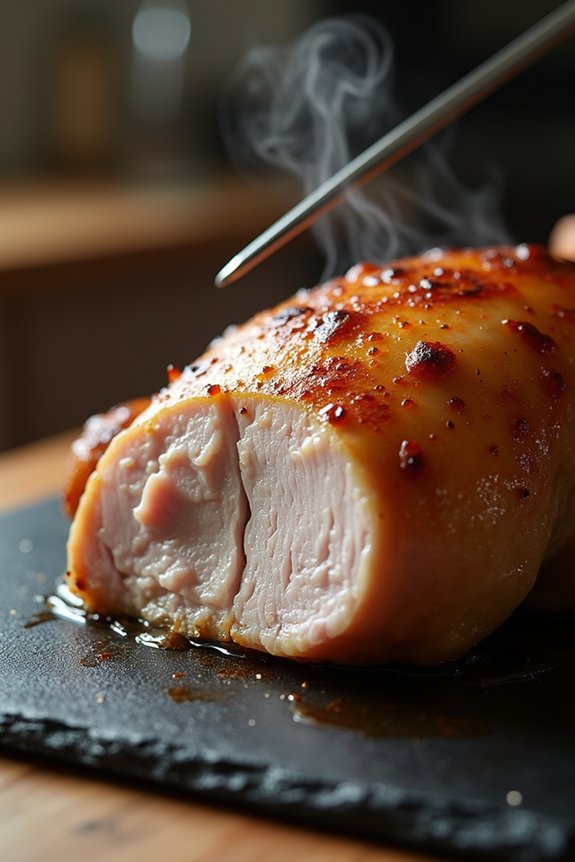
When should you actually check if your bone-in turkey breast is done? I start monitoring around the 65–75 minute mark using an oven-safe or wireless meat thermometer. Here’s my approach:
- Insert the thermometer into the thickest part of the breast
- Look for an interior temperature around 150–155°F at this checkpoint
- Recheck every 5–10 minutes if you’re in that range
- Plan for your final pull temperature of 155–160°F before resting
- Aim for 165°F after the meat rests
If your skin’s browning faster than the roasting time allows, loosely tent it with aluminum foil after the 65-minute mark. This prevents over-browning while your turkey reaches proper doneness. The thermometer becomes your best friend here—no guessing games allowed.
What to Do If Your Turkey Isn’t Done Yet: Extending Roast Time
Sometimes your turkey breast needs more time than you’d planned, and that’s totally okay—it happens to the best of us. Here’s where your thermometer becomes your best friend. If your bone-in turkey breast hasn’t reached 165°F after the initial roast time, don’t worry—just test every 5–10 minutes and keep roasting. Larger breasts often need up to 2.5 hours depending on size and oven quirks.
If the skin browns too quickly during your extend roast time, loosely tent with foil around the 65–75 minute mark and resume roasting. Once your thermometer hits 165°F in the thickest part, remove it immediately. The carryover heat will finish the job while you rest the meat loosely covered for 10–15 minutes, allowing resting juices to redistribute throughout.
Rest 20–30 Minutes for Juicier Meat
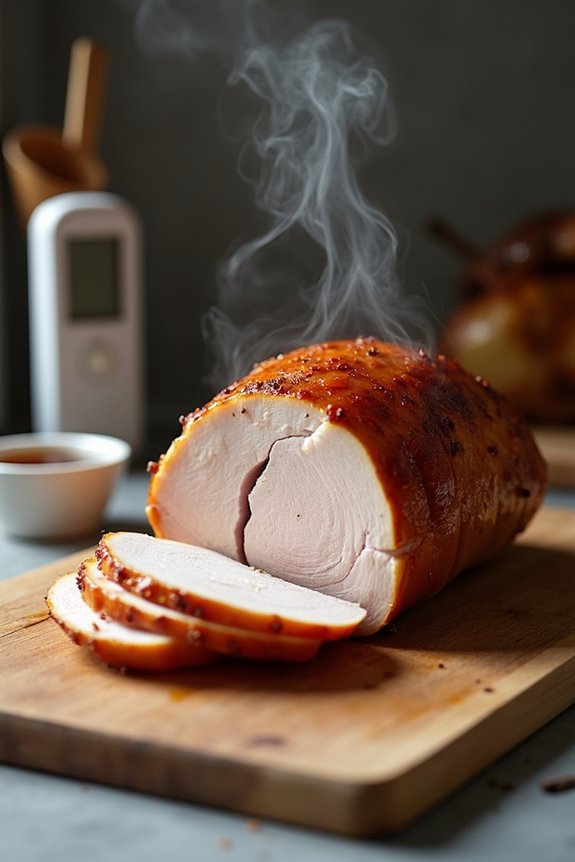
Why does resting matter so much? I’ve learned that skipping this step ruins everything you’ve worked toward. Here’s what happens during rest time 20–30 minutes:
Skipping the resting step ruins everything you’ve worked toward—don’t make that mistake.
- Juices redistribute throughout your bone-in turkey breast instead of running onto your cutting board
- Internal temperature continues rising safely without overcooking the exterior
- Muscle fibers relax, making meat tender and easier to slice
- Moisture stays locked inside rather than evaporating
- You’ll get juicy slices that actually taste incredible
Keep your breast loosely tented foil during resting—this maintains moisture without trapping steam that makes skin soggy. When you’re ready, slice across the grain on your cutting board for uniform, tender portions. Don’t skip this essential step; it directly transforms your turkey from dry to delicious.
Carve and Serve for Maximum Flavor
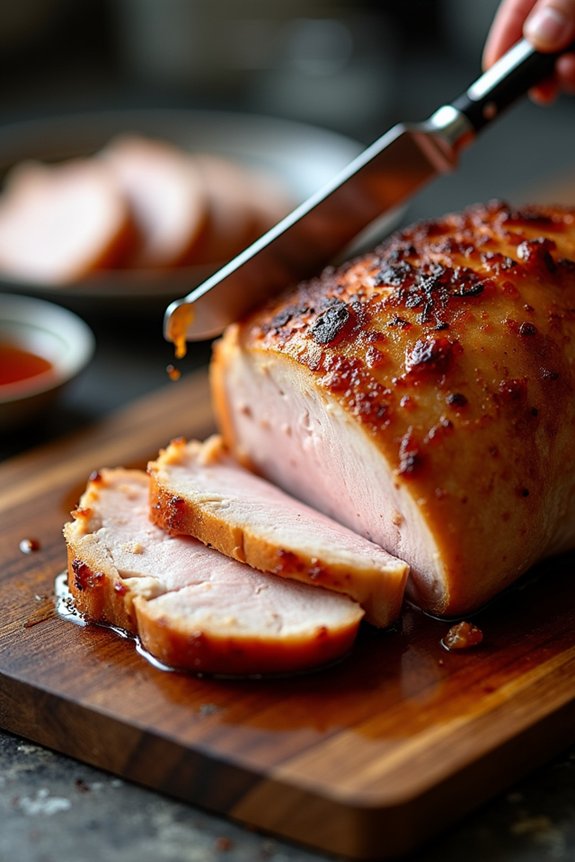
Your bone-in turkey breast is now rested and ready for the moment that matters—carving and serving it in a way that locks in all that juiciness you’ve worked to preserve. I’ll walk you through the process step by step.
| Step | Action |
|---|---|
| 1 | Separate each breast half from the center bone |
| 2 | Place meat on your cutting board |
| 3 | Slice across the grain for tenderness |
| 4 | Arrange slices on serving platter |
| 5 | Drizzle pan juices over top |
Separating the breast halves from the bone gives you control over your slicing direction. Cut against the grain—this breaks muscle fibers, making each bite more tender. Pool those precious pan juices right over your slices. They’re liquid gold for moisture and flavor. Finish with remaining drippings or gravy. You’ve got this.
Store Leftovers: Fridge (4 Days) or Freezer (3 Months)
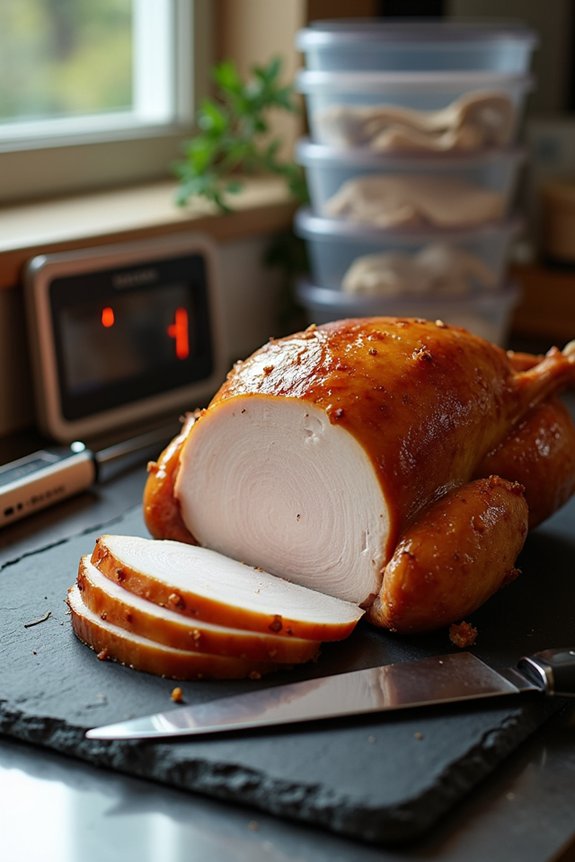
The key to enjoying your turkey breast beyond the first meal is storing it properly—and honestly, it’s easier than you might think.
I’ve found that removing meat from the bone and storing leftovers in airtight containers works best. Here’s what I do:
- Refrigerate leftovers for up to 4 days in airtight containers
- Freeze bone-in turkey breast for up to 3 months in freezer-safe bags
- Save pan drippings separately for gravy-making potential
- Slice portions before freezing for quicker thawing and even reheating
- Reheat all leftovers to 165°F internal temperature before serving
When you’re ready to reheat, you’ll appreciate how sliced portions thaw faster than whole pieces. I always let meat rest briefly after removing it from heat—this keeps everything tender. Your future self will thank you for this simple prep work.